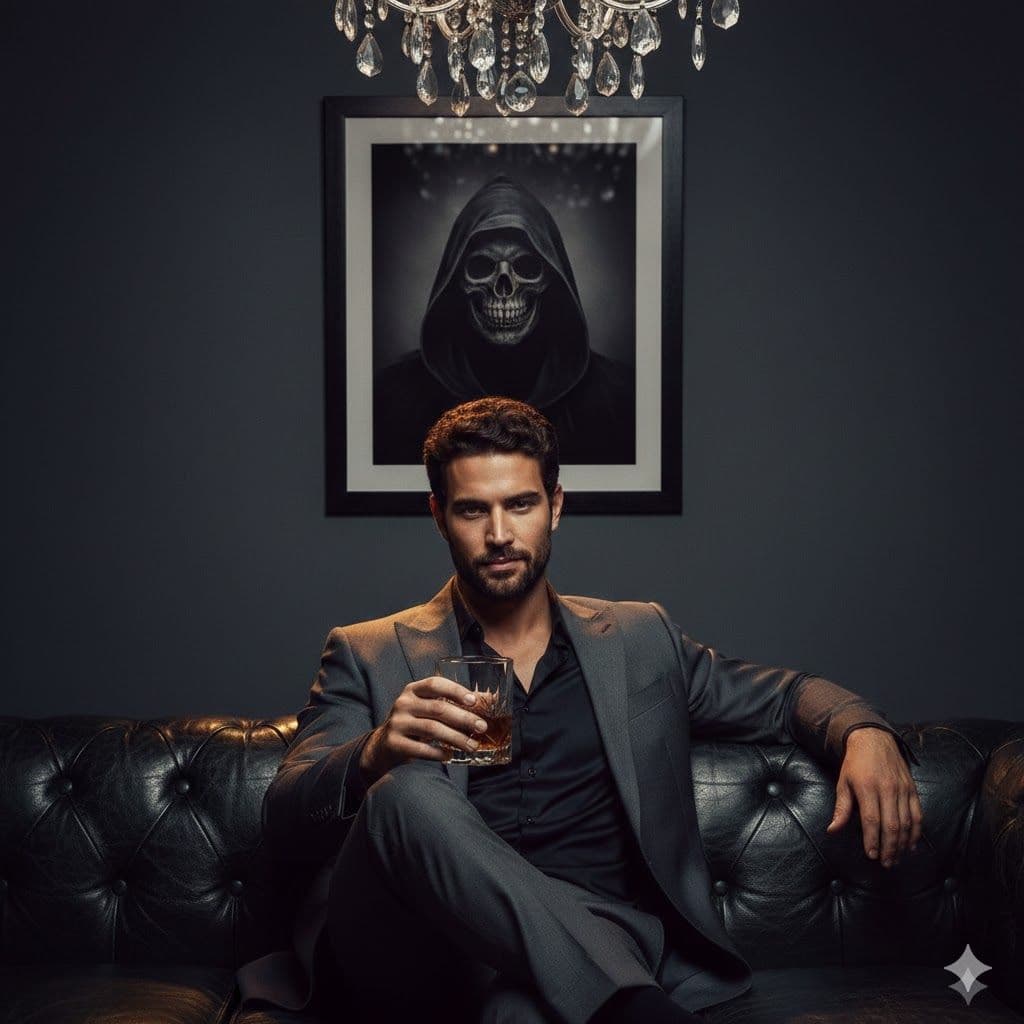
The Neo-Noir Sovereign
This cinematic AI portrait prompt delivers a Neo-Noir male portrait with locked facial identity, chiaroscuro lighting, and luxury material physics — engineered for creators who need photorealistic results that hold up at print scale
Getting the face to hold across those deep chiaroscuro shadows was the actual problem — the amber lighting kept bleeding into the jawline and washing out skin texture detail. I added the cranial proportions and micro-expressions language after about 25 test renders that came back looking like a wax figure. That one line changed everything
Tags
Prompt
Expected Output
The output centers on a sharply rendered male figure seated on a deep-button leather sofa, lit by warm amber rim light from above. Chiaroscuro shadows shape the face and suit, while a crystal whiskey glass reflects amber tones with convincing realism. Background skull artwork stays subtle, adding mood without pulling focus. Technically, the prompt pushes accurate facial structure with detailed proportions and natural skin texture, avoiding overly smooth results. The 35mm anamorphic look introduces oval bokeh and slight edge distortion, reinforcing a cinematic feel. HDR balance preserves shadow detail instead of crushing blacks. In my workflow, I use this for luxury-style personal branding without needing a full studio setup. It works especially well for LinkedIn headshots, pitch decks, and premium client visuals, cutting production time while keeping a high-end look.
- Color palette baked in — deep blacks, charcoal greys, and warm amber require minimal post-grade
- Skull artwork integrates into the background without overpowering the primary subject
- Leather sofa patina and fabric grain render as distinct surface textures, not merged grey blobs
- Anamorphic bokeh renders background bokeh as oval highlights, reinforcing cinematic lens character
- Amber whiskey glass refracts light with material-accurate optical physics, not a flat glow
- Chiaroscuro split-lighting carves dimensional, editorial contrast into the subject's face and suit
Parameters & Variables
| Variable Token | Meaning | Examples | Effect |
|---|---|---|---|
| FACE REFERENCE | The specific person whose facial identity is being locked into the portrait | young creative professionalMale executive | Swapping the reference shifts every identity-retention instruction — cranial proportions, micro-expressions, and follicular detail all recalibrate to the new face. |
| LIGHTING SCHEME | The primary lighting style applied to the subject's face and environment | split lightingRembrandt lightingChiaroscuro | Changing this shifts the entire mood — Rembrandt pulls the drama inward, soft box pushes toward a cleaner commercial look. |
| PROP / HAND ELEMENT | The object held in the subject's primary hand | bookcoffee cupsmartphonecigarCrystal whiskey glass | The prop reinforces the character narrative — whiskey reads as power and leisure, a book shifts toward intellectual branding, a phone grounds it in modern corporate context. |
| BACKGROUND ARTWORK | The framed piece mounted on the wall behind the subject | blank wallarchitectural blueprintvintage mapabstract dark oil painting | The artwork silently communicates character — skull art signals edge and confidence; abstract geometry reads as creative taste; blank wall focuses all attention on the subject. |
| LENS / APERTURE SPEC | The simulated camera and lens physics applied to the render | 50mm f/4 environmental35mm anamorphic f/1.8, 85mm portrait f/2.8 | Wider apertures deepen bokeh and isolate the subject harder; longer focal lengths compress background elements and shift the portrait toward classical headshot framing. |
Pro Tips / Best Practices
- 💡 Workflow Tip: If you're running this through ComfyUI with InstantID, feed the reference image at strength 0.8–0.85, not 1.0. Full strength tends to fight with the chiaroscuro shadow logic and produces flattened skin tones. The 0.8 range gives the lighting instructions enough room to work while keeping the identity locked.
- 📐 Aspect Ratio Guide: Run this at 2:3 (portrait) for print-ready outputs — business card headers, press kits, A4 profile pages. For LinkedIn banners or wide social headers, shift to 16:9 and adjust the composition instruction to "wide shot, subject seated slightly left of center frame."
- 🎛️ Customize It: The color grade palette is fully swappable. Replace "deep blacks, charcoal greys, and warm amber highlights" with "cool steel blue, slate grey, and silver" for a colder, more modern tech-executive read. Swap "premium black button-tufted leather sofa" with "minimalist concrete bench" to shift from old-money luxury to architectural editorial.
- 💬 My Personal Take: Honestly, the skull artwork detail is doing more work than it looks like. Without it the background reads as an empty grey void. But if you want a cleaner, corporate-safe version, just swap it for "large-format abstract oil painting" and the whole tone shifts without touching anything else. Watch the chandelier instruction though — on some SD checkpoints it renders as a ceiling fan.
- 👤 Who Should Use This: Photographers building AI portrait packages for executives, influencers, or LinkedIn personal brands. Also strong for Fiverr/Etsy sellers offering custom AI headshots — the face-locking language is what separates this from generic portrait prompts that swap out the subject's face entirely.