Photorealistic Duality Horror AI Prompt for Dark Fantasy Game Concept Art
A man locked in a baroque mirror standoff with his own enraged reflection — this cinematic horror AI prompt delivers photorealistic dual-expression portraiture with chiaroscuro precision and Victorian gothic atmosphere
Tags
Prompt
Expected Output
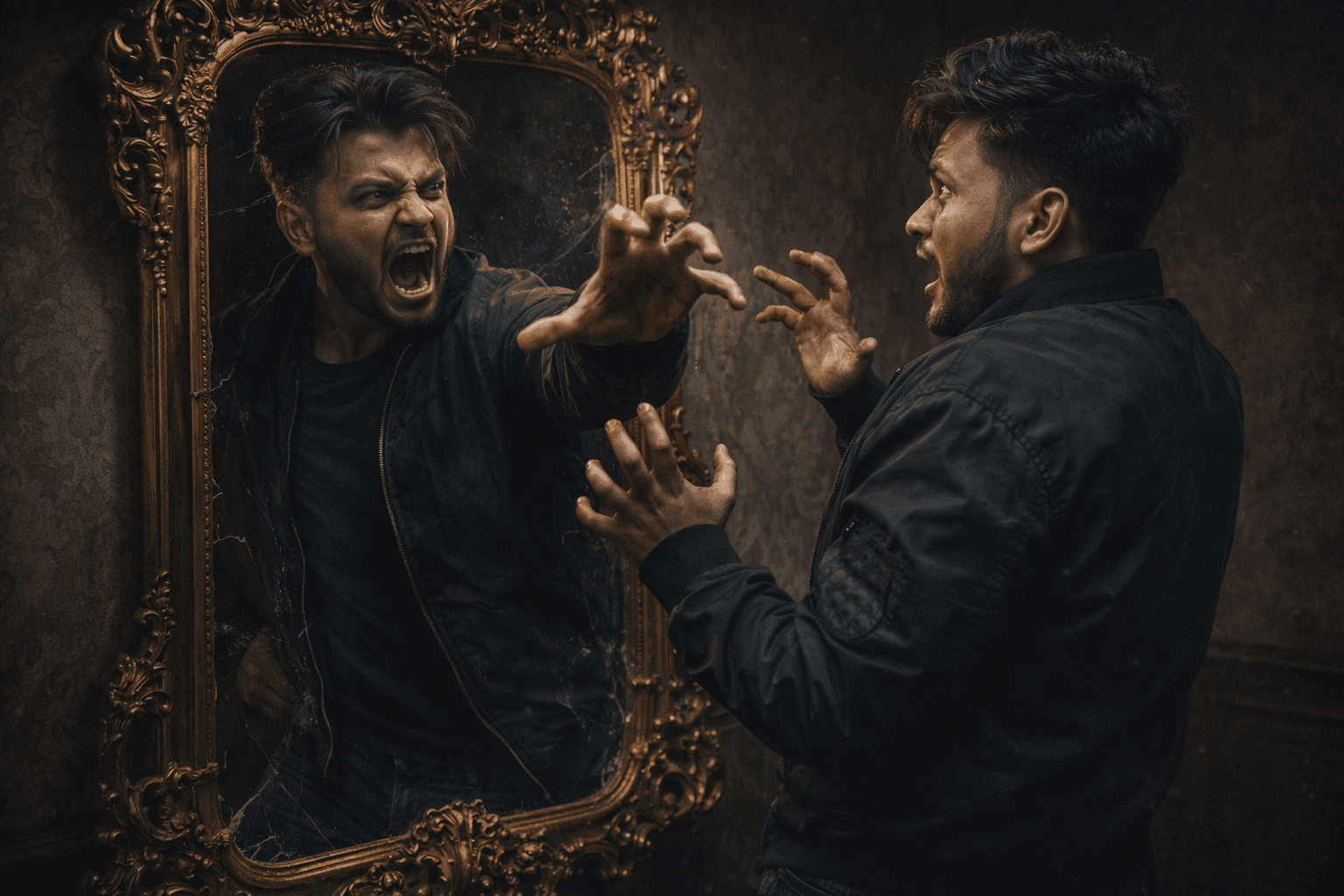
This prompt creates a cinematic, high-contrast portrait of two identical men divided by an ornate gilded mirror. One is frozen in terror, the other twisted in rage, forming a striking dual-emotion composition. The baroque frame is cracked where the reflection breaks through, with an arm and torso emerging into reality. Victorian damask wallpaper, floating dust, and low ambient lighting build a tense psychological horror atmosphere rooted in surreal mirror imagery. The output features detailed skin rendering with visible pores, sweat, and subsurface scattering for realism. Dual-zone chiaroscuro lighting separates the scene: soft, natural tones on the real side contrast with deep shadows and harsh light inside the mirror. The glass-breaking transition remains clean and physically believable, optimized for high-resolution results. Perfect for concept artists, game designers, and film pre-production needing cinematic, psychologically intense visuals.
- Cracked gilded baroque frame with precise structural damage centered at the reflection's breach point
- Dual micro-expressions: visceral, wide-eyed terror on the subject versus sharp, muscular rage on the twin
- Chiaroscuro dual-zone lighting separates soft real-world ambiance from sinister high-contrast mirror interior
- Victorian damask wallpaper and suspended dust motes build a suffocating, claustrophobic psychological atmosphere
- Photorealistic skin texture with visible sweat beads, pores, and subsurface scattering — zero over-smoothing
- Clean, soft-edge masking where the reflection's arm and torso cross the mirror threshold into physical space
- 8K resolution output suitable for large-format print, game pre-production concept sheets, and cinematic mood boards
Parameters & Variables
| Variable Token | Meaning | Examples | Effect |
|---|---|---|---|
| SUBJECT | The primary human figure standing before the mirror — the "real" person | — | hanging the subject's age, gender, or cultural context shifts the psychological narrative and wardrobe/environment pairing entirely. |
| MIRROR FRAME STYLE | The architectural and decorative style of the mirror frame | art deco chrome,\baroque gilded | Frame style controls the historical period, atmosphere, and color accent (gold warmth vs. cold metallic vs. dark stone tones). |
| REFLECTION EXPRESSION | The emotional state displayed on the emerging reflection's face | ecstatic joycold emotionless blankrage and malice | Alters the psychological tone of the entire scene — swapping rage for blank detachment shifts horror genre from aggressive to uncanny. |
| ENVIRONMENT | The room and background context surrounding the mirror | candlelit gothic chapebrutalist concrete corridorfaded Victorian parlor | Environment controls color palette, atmospheric density, and the cultural/temporal reading of the horror narrative. |
| LIGHTING MODE] | The dominant lighting logic applied across the scene | neon rim lightinggolden-hour window backlightharsh single overheaddual-zone chiaroscuro | Lighting mode is the primary driver of mood — chiaroscuro maximizes sinister contrast, while warm backlight would create an ambiguous, dreamlike tone instead. |
Pro Tips / Best Practices
- 🎛️ Customize It: Swap the matte black bomber jacket for Victorian-era waistcoat and cravat to shift the setting into a full period-piece horror narrative. Wardrobe consistency between subject and reflection is non-negotiable — any divergence visually breaks the identity-twin logic the entire composition depends on.
- 📐 Aspect Ratio Guide: In Midjourney v6, append --ar 2:3 to emphasize the mirror's vertical drama and frame both figures in full height. Use --ar 16:9 for widescreen cinematic output — ideal for film mood boards and game environment concept sheets.
- 🎨 Style Pairing: Add a film grain overlay and slight vignette in post-processing to push this into a 1970s psychological thriller aesthetic — think The Shining color palette. Cool blue-grey shadows already in the prompt prime the image for this grading.
- 💡 Workflow Tip: Game developers can isolate the reflection figure by running a second prompt pass describing only the mirror interior with a neutral dark background — this produces a clean silhouette usable for 2D sprite extraction or character sheet documentation.
- 🖨️ Output Optimization: The 8K specification makes this output print-ready at up to 24×36 inches. Request a second variant with a neutral grey room to simplify background removal in Photoshop or Figma for poster or book cover design use.